The Bow Rider
The Quarterly Newsletter of the Galveston Bay Dolphin Research Program

October – December 2025
Galveston Bay Foundation is pleased to share The Bow Rider, the Galveston Bay Dolphin Research Program‘s (GDRP) quarterly newsletter. Thank you for your interest in our research!
A Splashy Overview
The last quarter of 2025 began with the completion of post-biopsy boat surveys. The field crew pushed through challenging conditions to find and photograph the dolphins that were biopsied in September. These follow-up surveys are important to track the healing progress of the small wounds that resulted with the collection of skin and blubber samples. Details about the remote biopsy effort were shared in the October 2025 Bow Rider.
In December, we initiated winter season coverage of our primary study area, beginning the surveys once water temperatures were consistently below 23 °C. During three surveys (245km of linear effort; 22hrs of observation), our team observed 172 dolphins in 24 sightings.

October through December 2025.
Have you seen dolphins in Galveston Bay or surrounding waters?
Please tell us about it by filling out our sighting form. This is an easy and effective way to notify the GDRP about when and where you have seen dolphins. Always follow dolphin safe viewing guidelines.
During one of our post-biopsy surveys, the team observed a subgroup of dolphins chasing fish close to the southern shoreline of the Mid-Bay Spoil. Several of our well-known resident dolphins were part of this group, including adopted dolphin Cruiser (#412). This was an exciting observation for our team, as it is unusual to see natural foraging behaviors in this area!


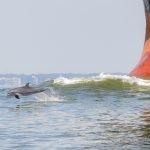
Dolphins (from left to right) #378, Cruiser (#412), and #128 getting close to the Mid-Bay spoil island while chasing fish during an October sighting.
News & Updates
That’s a wrap on 2025! It was a busy and exciting year for the GDRP. In total, we conducted 39 boat-based dolphin observation surveys and collected visual data on 249 dolphin groups (2487 dolphins). In 2025, we completed our 300th boat-based dolphin survey! We trained 26 new volunteers for land-based survey efforts, and seven volunteers for our Dolphin Ambassador program. GDRP volunteers donated 1,361 hours in 2025, doubling the number of hours donated in 2024. THANK YOU!
We continued and expanded our land-based monitoring efforts at Seawolf Park, where we conducted 53 land-based dolphin observation surveys, resulting in the observation of nearly 900 dolphins. At the Park, our team engaged with 612 members of the public to educate them about our research and dolphin-safe fishing tips. In 2025, we completed our 100th land-based dolphin survey!


The GDRP was involved in many collaborative projects in 2025. We collected 35 dolphin tissue samples during remote biopsy surveys as part of a project funded through NOAA’s RESTORE Science Program. We participated in a groundbreaking project, Passive Health Assessment of Sea Mammals (PHASM), funded by Dolphin Quest. Collaborators at Stephen F. Austin State University and Oklahoma State University joined our team in Galveston Bay to deploy the PHASM drone to collect blow samples from wild dolphins for the first time!


We presented our work at two conferences in 2025: the Gulf of America Alliance’s All-Hands Meeting in Biloxi, Mississippi; and the Society of Environmental Toxicology and Chemistry’s North America Annual meeting in Portland, Oregon.
The latter half of 2025 represented a significant period of growth and transition for the GDRP. Established in 2014 through a partnership between the Galveston Bay Foundation and the Environmental Institute of Houston at the University of Houston-Clear Lake (UHCL-EIH), the program has continued to evolve over the past decade. We are pleased to share that the Galveston Bay Foundation will now serve as the primary lead for the GDRP as it expands into a broader collaborative effort with UHCL-EIH and additional partners.
Lola Renauer, a doctoral student at the University of South Carolina and GDRP Project Affiliate, presented the first step of her dissertation work at the Society of Environmental Toxicology and Chemistry’s North America Annual meeting in Portland, Oregon. For her dissertation, she will be applying the FRESH protocol, developed by the GDRP and collaborators, to evaluate freshwater-related skin lesions in Galveston Bay dolphins.

In October, Galveston Bay Foundation’s Volunteer Manager, Elisa O’Neal, and GDRP’s Research Associate, Alyssa Quackenbush, hosted the first training workshop for volunteer Dolphin Ambassadors. We trained seven Dolphin Ambassadors, who will assist the GDRP in our mission of inspiring the public to care about local dolphins and take action to protect them. The training was a great success, and some of the volunteers have already put their skills to work (read about the Port Houston event below)!

Four of our newly minted GDRP Dolphin Ambassadors hosted a booth at Port Houston’s Community Resource Fair in December. Our volunteers shared information about Galveston Bay dolphins, how the GDRP conducts research, and how the public can join us in our efforts to protect and conserve them.

In December, we said a very difficult goodbye to Sherah McDaniel (Senior Research Associate with UHCL-EIH). Sherah has been with the program since it was established in 2014, starting as a master’s student at UHCL. She left after completing her degree, but returned in late 2022 as a Research Associate and was our boat survey lead for almost three years. Over the holiday break, Sherah moved to Oregon to be with her family. We are sad to see her go but are so happy for her to be with her loved ones. We are incredibly grateful for all of the hard work and sacrifices she has made for the GDRP over the years. She will always be a part of the GDRP team, and we look forward to her joining us for special projects and events. We will miss you, Sherah!


Adoptee Highlights
Don’t miss out! Adopt or name a dolphin to join our Dolphin Society and receive exclusive updates about individual dolphins. Your support goes directly to the Galveston Bay Dolphin Research Program.
A huge THANK YOU to everyone who named or adopted a dolphin during our holiday campaign! It is our most important annual fundraiser, and we are so grateful for your generosity.


What YOU want to know…
“Why can I NOT interact with dolphins?”
In the United States, dolphins are protected under the Marine Mammal Protection Act (MMPA), which prohibits the harassment of all marine mammals (MMPA, 1972). Under this legislation, harassment is defined as “acts of pursuit, torment, or annoyance” that have the potential to harm marine mammals (MMPA, 1972). Activities such as feeding or attempting to feed dolphins, following them with a boat, trying to catch them with fishing gear, or attempting to touch them can be dangerous for dolphins and humans.
Some of these actions can result in dolphins becoming habituated to human presence. The more dolphins approach humans or vice versa, the more risk they have of being injured by boat propellers, fishing gear, or intentional harm from people (NOAA, 2025). Your actions may feel small in the moment, but they have the potential to produce long-term and detrimental impacts to marine mammal health and behavior. Additionally, dolphins in the wild are, well, wild! They are unpredictable and untrained and may react unexpectedly to your actions. Not only is it in the dolphin’s best interest to be left alone, but it is also for your safety. So, what do you do if you see dolphins or other marine mammals in the wild?
When viewing dolphins from a boat, maintain a distance of at least 50 yards, limit viewing time to no more than 30 minutes, put your engine in neutral, and avoid approaching or encircling the animals (NOAA, 2025). If you own a watercraft and operate in areas with dolphins, we highly encourage you to read the guidelines below to ensure safe viewing. When observing dolphins from land, do not throw objects or food into the water, avoid fishing in the immediate area, and never attempt to swim near them (NOAA, 2025).
It’s exciting to see dolphins in the wild, so enact safe viewing and educate those around you to ensure their protection!
If you have a question regarding GDRP, Galveston Bay dolphins, or dolphin biology, please submit your question using the button below.
Thank You to Our Collaborators!
Thank you to all of our individual supporters, sponsors, and partners, who make this work possible! We are grateful for your continued support.


All activities are conducted under a NMFS Scientific Research Permit.
Galveston Bay Foundation
1725 Highway 146
Kemah, TX 77565
(281) 332-3381