The Bow Rider
The Quarterly Newsletter of the Galveston Bay Dolphin Research Program

January – March 2025
Galveston Bay Foundation and the Environmental Institute of Houston (University of Houston-Clear Lake) are pleased to share the inaugural edition of The Bow Rider, the Galveston Bay Dolphin Research Program‘s (GDRP) quarterly newsletter. Thank you for your interest in our research!
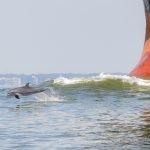
We are thrilled to announce that our quarterly newsletter has been revamped and named The Bow Rider! We chose The Bow Rider as a tribute to one of the most common dolphin behaviors we observe in Galveston Bay – bow riding on vessels. Did you know our GDRP logo features two bow riding dolphins? We hope you enjoy this inaugural edition!
A Splashy Overview
During the first quarter of 2025, the saga of frequent fog continued during low wind days. The team also faced the expected cooler temperatures of winter. Regardless, over the course of seven surveys, the team observed 308 dolphins during 39 sightings (equaling 522km and 44 hours of observation effort). Most sightings occurred in the Houston Ship Channel and Lower Galveston Bay, as we have come to expect during cooler water temperatures.

Have you seen dolphins in Galveston Bay or surrounding waters?
Please tell us about it by filling out our sighting form. This is an easy and effective way to notify the GDRP about when and where you have seen dolphins. Always follow dolphin safe viewing guidelines.
In March, we observed our first two neonates (newborn dolphins) of the year in Lower Galveston Bay! These new calves were surfacing tight with their moms in quick, uncoordinated head-out surfacings characteristic of neonates. Other attributes of newborns are their dark coloration and fetal folds, or the vertical lines that you see on their bodies from being folded in their mother’s wombs.

The crew was excited to experience “clear” water where we were able to see down to more than 1.2 meters deep. This does not happen very often in our area, so it is a treat to be able to see dolphins underneath the water! We are typically limited in our observations of marine life to what we can see at the surface. During one clear-water sighting, we observed an interaction between dolphins and a ~4ft alligator gar. The interaction was brief where we saw splashing at the surface and the gar breaching the surface. The dolphins soon moved on and we saw the fish swim safely away!

News & Updates
The GDRP participated in a working group hosted by the Texas Parks and Wildlife Department (TPWD) to determine the conservation status of bottlenose dolphins (Tursiops truncatus) in Texas waters. This effort was part of a periodic evaluation of the state’s Species of Greatest Conservation Need species’ status. Updated rankings provide the most accurate conservation information for bottlenose dolphins within the State Wildlife Action Plan (SWAP).
After insightful discussions, the working group determined a ranking of “S3?” for bottlenose dolphins. In SWAP, species are ranked from S1 to S5, with S1 being “critically imperiled” to S5 being “secure.” The “S3” means that bottlenose dolphins are “vulnerable.” The “?” was included to denote that dolphin populations in Texas may rank between S2 and S4, since there are key differences between dolphins that live within Texas’ bays and those in coastal Gulf waters. Generally, bay dolphins are more vulnerable than their coastal counterparts due to their close proximity to humans.
We were very grateful to be a part of this assessment process, as a species’ designated status can have considerable impact on the management and conservation of a species and its habitats.

On January 29th, we celebrated GDRP volunteers at Galveston Bay Foundation’s annual volunteer appreciation event, Bravos for the Bay. We were thrilled to spend a fun and relaxing evening with our citizen scientists who are an integral part of our boat and land research crews. GDRP volunteers contributed nearly 700hrs in 2024 to dolphin research and outreach efforts. THANK YOU!
Volunteer With Us!
We are currently accepting applications for volunteer citizen scientists at our land-based Dolphin Research and Outreach Station at Seawolf Park in Galveston. The Seawolf Station consists of a group of 3-4 volunteers who collect dolphin sighting data from land and take photographs of dolphins, while engaging with park visitors/fishers to educate them on how marine debris can affect dolphins.
We will be hosting a 2-day training workshop for selected applicants on May 31 and June 1. If you are interested in applying for this unique citizen science opportunity, please see the Seawolf Station Application Form.
Applications are due Friday, May 2nd.


Adoptee Highlights
Don’t miss out! Adopt or name a dolphin to join our Dolphin Society and receive exclusive updates about individual dolphins. Your support goes directly to the Galveston Bay Dolphin Research Program.
We want to extend a huge thank you to an anonymous donor who generously named Pappy (#188) this quarter.

Gift a Galveston Bay dolphin for Mother’s Day!

Consider adopting or naming a dolphin as a gift for your mom this Mother’s Day! Sheba (#314) was seen with her calf this quarter and is one of three dolphin moms available for adoption this Mother’s Day – Mariner (#23), Angelique (#39), and Sheba (#314). Dolphin moms #42 and #87 are available for naming. Gift adoption kits are delivered electronically and include photographs of your adopted dolphin, a sighting map, and a one-year membership in our Dolphin Society. The deadline to adopt or name a dolphin for Mother’s Day is Thursday, May 8 at 3 pm CDT.
What YOU want to Know…
“Do you tag dolphins in Galveston Bay?”
Many types of tags may be used on cetaceans to gather valuable data. Some are useful for identification purposes, though many tags use VHF radio or satellite transmissions to track the location of an animal. More advanced tags are able to monitor physiological, behavioral, and/or environmental data such as depth, respiration patterns, and water temperature. Some tags even take video to get a “dolphins-eye” view of the ocean.
One thing that these tags all have in common is that attaching one to a highly mobile marine mammal is not an easy task! Due to this challenge, we have not yet tagged any dolphins in Galveston Bay, but we hope to in the future. The type of tag we would use depends on the questions we are trying to answer about Galveston Bay dolphins and the safety of the tagged animal (read more about cetacean tagging: Andrews et al., 2019).
Typically, dolphins have to be captured so that a tag can be placed, either using suction cups for short-term tag projects (lasting several hours), or using a longer-lasting bolt attachment into the dorsal fin (sort of like a large earring!) for tags that can last up to several months. However, exciting new technology developed with help from our colleagues at the Sarasota Dolphin Research Program (Moore et al., 2024) provides an alternative approach for tagging dolphins while they bow ride in the wild. We will be watching the development of this technology and considering how we might implement it to tag dolphins here in Galveston Bay for future projects.

If you have a question regarding GDRP, Galveston Bay dolphins, or dolphin biology, please submit your question using the button below.
Thank You to Our Collaborators!
Thank you to all of our individual supporters, sponsors, and partners, who make this work possible! We are grateful for your continued support.


is a collaboration between the Galveston Bay Foundation and the Environmental Institute of Houston at the University of Houston-Clear Lake.
All activities are conducted under a NMFS Scientific Research Permit.
Galveston Bay Foundation
1725 Highway 146
Kemah, TX 77565
(281) 332-3381
Environmental Institute of Houston
University of Houston at Clear Lake
2700 Bay Area Blvd.
Houston, TX, 77058
(281) 283-3950