Galveston Bay Dolphin Research Program Activities
April – June 2024
Galveston Bay Foundation and the Environmental Institute of Houston (University of Houston-Clear Lake) are pleased to share the latest Galveston Bay Dolphin Research Program (GDRP) quarterly newsletter. Thank you for your interest in our research!
A Splashy Overview
It was a challenging and busy quarter for our team and Galveston Bay dolphins! In May and June, our team surveyed our study area in four days (214km of linear effort; 20hrs of observation), resulting in the observation of 19 dolphin groups with approximately 160 individual dolphins. In the two weeks preceding the surveys, heavy precipitation (up to 15 inches in some areas) fell in the Galveston Bay watershed leading to a low salinity event in the Bay. Although in June we tend to observe high concentrations of dolphins in upper Bay, encounter rates (dolphins/km) this year were relatively low and the majority of sightings occurred in dredged channel habitat. Dolphins moved to deeper waters and to lower Bay (near the mouth of the estuary) likely in response to shifts in prey distribution resulting from the salinity flux. We also suspect that Bolivar Roads pass and even nearby coastal waters may be a refuge for Bay resident dolphins during low salinity events.
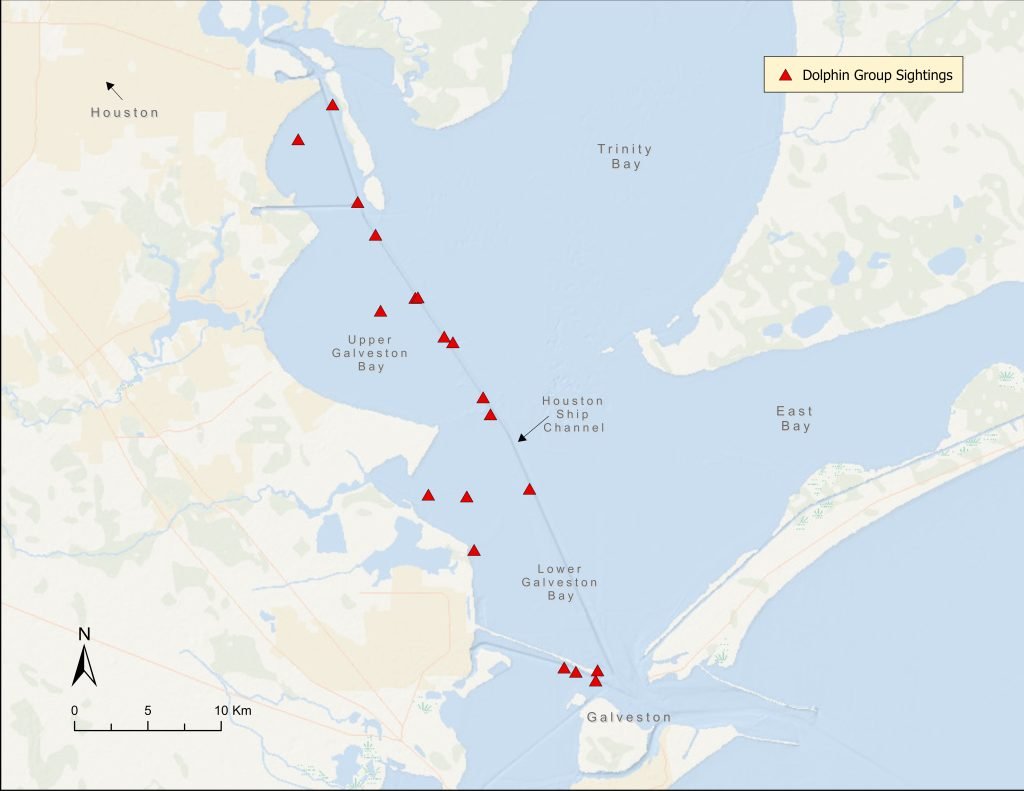
Have you seen dolphins in Galveston Bay or surrounding waters?
Please tell us about it by filling out our sighting form. This is an easy and effective way to notify GDRP about when and where you have seen dolphins. Always follow dolphin safe viewing guidelines.

Our team and collaborators have been busy preparing to start field work in August for the RESTORE Science Program Dolphin Multiple Stressors Assessment. As we get ready, we are being starkly reminded of why Galveston Bay was chosen as the study site for this project that aims to understand the cumulative effects of multiple stressors on dolphins. As described above, this quarter, the Houston-Galveston region endured major flooding from Spring rains, with freshwater runoff creating extreme low salinity conditions. This change in salinity, combined with increases in pathogens and contaminants contained in runoff water, creates stress on the estuary and its inhabitants. Effects include evacuation of fish populations from the Bay, oyster die-offs, and an increased risk to the health of resident dolphin populations.
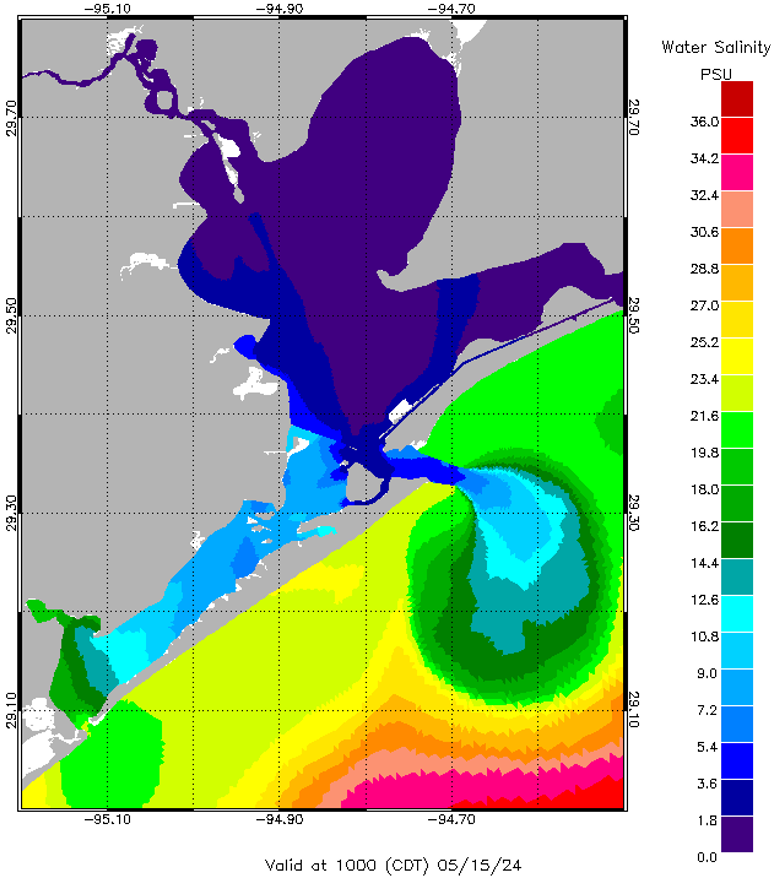
Surface salinity in Galveston Bay on May 15, 2024, courtesy of NOAA’s salinity tracker. This was about two weeks after the major flooding events in Southeast Texas in early May. Almost the entire Bay was still below 5ppt. Low salinity events can affect dolphin distribution and lead to the development of freshwater skin lesions.
But the low salinity event wasn’t the only news-worthy event! On May 15th, a barge hit the Pelican Island causeway. The accident resulted in an oil spill into the Galveston Ship Channel and “Back Bay”. Oil exposure can have many negative health consequences for marine animals, including reduced reproductive success, increased rates of infection, and increased susceptibility to lung and cardiac disease. To top off these stressors, severe weather has been abundant in the area so far this year, which also has the potential for temporary and lasting effects on estuaries and wildlife (see “What You Want to Know” about hurricanes and dolphins). We continue to be in awe at the resilience of our dolphins and look forward to learning more about how these stressors combine to affect their lives.

GDRP hosted two volunteer training workshops in June, welcoming a total of 27 new citizen scientists to our team! The Field Assistant Volunteer Workshop took place on June 15. At this one-day event held at EIH-UHCL, we began training volunteers to assist our research crew during our observational boat surveys. During surveys, they will be primarily responsible for searching for dolphins and scribing data during observations. The workshop covered detailed background information about our research, boat safety, and hands-on data collection practice. Over the next year, these volunteers will complete their training on the water.

The workshop included hands-on training on equipment used during observational surveys
The following weekend in June, we hosted a two-day workshop to train volunteers for our Dolphin Research and Outreach Station at Seawolf Park, Galveston. The first day of the workshop took place at EIH-UHCL where we covered background material on research methods, outreach engagement, and safety measures. We were grateful that Heidi Whitehead, Executive Director of the Texas Marine Mammal Stranding Network, joined us to discuss strandings and the threats that entanglement in fishing gear poses to dolphins.

On Sunday, the workshop continued on-site at Seawolf Park, where volunteers received hands-on training in data collection, photography, and outreach strategies. These newly trained citizen scientists will collect dolphin observational data from land, while engaging with park visitors and fishers to educate on how marine debris can affect wildlife. Following the workshop for our new volunteers, our staff met onsite with existing volunteers to offer a refresher training and explain improvements to the protocols. Our staff truly enjoyed getting to know our new citizen scientists and spending time with last year’s cohort!
In April, two of our team members traveled to Beaufort, North Carolina for the 2024 Southeast and Mid-Atlantic Marine Mammal Symposium. They eagerly soaked in the awesome research being done in the Southeast US! Alyssa Quackenbush, GDRP Research Associate, presented preliminary results from our Dolphin Research and Outreach Station in a presentation titled “Land-based surveys conducted by citizen scientists: What can we learn about dolphin-fisher interactions?”. Thank you to our volunteers, partners, and sponsors for supporting this ongoing citizen science initiative at Seawolf Park!

We are happy to welcome two new members to the team! Ryan Pittsinger is a Research Assistant that will be helping us through October. He recently graduated from the University of Miami’s (UM) Rosenstiel campus with a Master of Professional Science (MPS) in marine mammals. His thesis centered around the creation of presence models for bottlenose dolphins in the Gulf of Alghero, Sardinia. He will be helping with field work and data analysis. Jamie Mazurski is a summer research intern who will also be helping with surveys and data analysis, as well as completing an independent research project focused on the passive acoustic monitoring of dolphins in Galveston Bay. She is currently a graduate student at UM, finishing up her MPS degree in marine mammal science. Welcome Ryan and Jamie!


Adoptee Highlights
The content of this section is available to current members of our Dolphin Society. To become a member and receive updates on our individual dolphins, please adopt or name one of our dolphins. Adoption kits are a fun and unique gift! All funds go directly to the Galveston Bay Dolphin Research Program.

We want to extend a huge thank you to everyone that adopted a dolphin during this year’s Mother’s Day campaign. The campaign is one of our largest annual fundraisers and provides vital support for our program.
A special thank you to Kenny Owen who generously named Amorzinha (#231) to honor and celebrate the wonderful and nurturing mother that is Gaby Owen, and to Michael Brisch who generously named Stella (#582) to honor his wife, Karen Brisch. THANK YOU!
What YOU want to Know…
“What do dolphins do during a hurricane?”
With the passing of Hurricane Beryl, some of you are wondering how a hurricane affects our local dolphin population. Hurricanes can cause drastic environmental changes in a very short time span, and how animals adapt to sudden changes in water quality is an important research question.
In a study following Hurricane Harvey, we documented a noticeable decrease in the number of dolphins in upper Galveston Bay during the low-salinity event associated with the storm (Fazioli and Mintzer, 2020). A shift in dolphin distribution was observed with most animals found in deep channels, rather than shallower near-shore or open bay waters, similar to what we’ve seen this quarter after the Spring rains. Studies have found drastic changes to fish community composition and distribution following storms, likely driven by a sudden decline in dissolved oxygen (Paperno et al., 2006; Dula et al., 2022). Dolphins likely respond to this shift in prey distribution and thus exhibit similar movement patterns. Other studies in Maryland and the Mississippi Sound have also found lower bottlenose dolphin encounter rates during and directly after hurricanes and intense storms (Smith et al., 2013; Fandel et al., 2020). While most dolphins temporarily change their distribution, there is evidence that their long-term residency is unaffected by storms (Bassos-Hull et al., 2023).

The Sarasota Dolphin Research Program (SDRP) tracked the movements of bottlenose dolphins during hurricanes using satellite-linked tags. During Hurricane Ian that hit Florida’s west coast, four offshore dolphins moved with the direction of the hurricane generated winds and currents (see map above). One dolphin was tracked during Hurricane Florence off the coast of North Carolina. The dolphin returned closer to shore once the hurricane was ashore, but she stayed off of the areas affected by the freshwater influx from the flooding. Although there is still much to learn about how dolphins respond to hurricanes, we now know to expect noticeable effects on distribution and movement.
If you have a question regarding the GDRP, Galveston Bay dolphins, or dolphin biology, please submit your question using the button below. We select questions to answer from your submissions. We look forward to knowing what YOU want to know!


is a collaboration between the Galveston Bay Foundation and the Environmental Institute of Houston at the University of Houston-Clear Lake.
All activities are conducted under a NMFS Scientific Research Permit.
Galveston Bay Foundation
1725 Highway 146
Kemah, TX 77565
(281) 332-3381
Environmental Institute of Houston
University of Houston at Clear Lake
2700 Bay Area Blvd.
Houston, TX, 77058
(281) 283-3950